
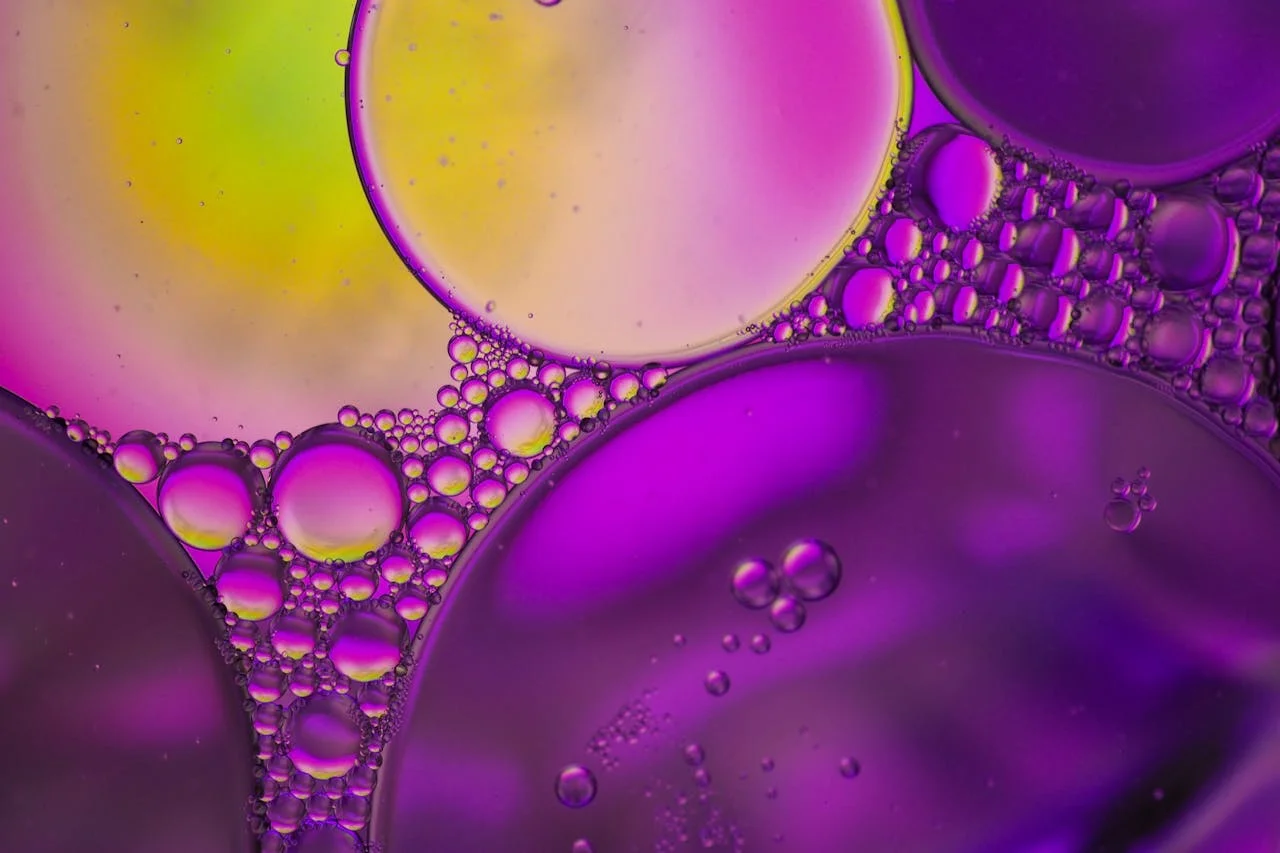
The Science of Emulsions: Mixing Oil and Water?
The familiar phrase “like oil and water” exists for a fundamental scientific reason: oil and water are immiscible. This means they do not form a homogeneous mixture on their own. The root cause lies in the polarity of their molecules. Water is a polar molecule, meaning it has a slight positive charge on one end and a slight negative charge on the other. This polarity allows water molecules to form strong hydrogen bonds with each other. Oil, however, is composed of nonpolar molecules with an even distribution of electrical charge. How do molecular forces cause separation? The strong cohesive forces between water molecules “squeeze out” the nonpolar oil molecules, which are unable to break the hydrogen-bonded network. This results in the two liquids quickly separating into distinct layers to minimize the surface area between them, a state of lower energy.
This separation is driven by surface tension at the interface between the two liquids. Creating a mixture requires overcoming this natural tendency, which is both thermodynamically unfavorable and unstable. Simply shaking the two liquids together will only create a temporary, chaotic mixture. The oil will be dispersed as tiny droplets throughout the water, but they will rapidly coalesce and rise back to the top. To create a stable, long-lasting mixture of oil and water, you need a third component—an emulsifier—and an understanding of the energy required to create and stabilize the enormous increase in surface area between the two phases.
The Solution: The Role of Emulsifiers
An emulsifier is a substance that stabilizes an emulsion. These are molecules that have a unique dual nature; they are part polar (hydrophilic, or “water-loving”) and part nonpolar (lipophilic, or “oil-loving”). This structural duality makes them perfect for bridging the gap between oil and water. When added to a mixture of the two immiscible liquids and agitated, the emulsifier molecules position themselves at the interface between the oil droplets and the water. How does an emulsifier stabilize the mixture? The nonpolar tail of the emulsifier embeds itself into the oil droplet, while the polar head group remains in the water phase. This forms a protective barrier around each droplet, reducing the surface tension and preventing the droplets from coalescing.
Common emulsifiers include lecithin (found in egg yolks, which is why mayonnaise is so stable), proteins, and various synthetic molecules. In an oil-in-water (O/W) emulsion, like milk or vinaigrette, tiny oil droplets are dispersed in a continuous water phase. In a water-in-oil (W/O) emulsion, like butter, tiny water droplets are dispersed in a continuous oil phase. The type of emulsion formed often depends on the properties of the emulsifier and the ratio of the liquids. By acting as a molecular mediator, the emulsifier provides kinetic stability, allowing the emulsion to exist for a useful period without separating.
The Science: Creating and Stabilizing Emulsions
Creating a stable emulsion is a two-step process that involves both energy input and chemical stabilization. The first step is dispersion, where mechanical energy is applied to break one of the liquids into tiny droplets. This can be achieved through vigorous shaking, whisking, blending, or using specialized equipment like homogenizers or rotor-stators. This process significantly increases the surface area between the two phases, which is why it requires substantial energy input. Why is creating small droplets so important? Smaller droplets have a slower rate of coalescence and creaming (rising to the top) or sedimentation (sinking to the bottom), leading to a more stable emulsion.
The second, crucial step is stabilization. Even with small droplets, they will eventually coalesce without an emulsifier. The emulsifier must quickly migrate to the newly created interfaces to coat the droplets. Other factors that contribute to emulsion stability include the viscosity of the continuous phase—a thicker liquid slows down droplet movement—and the pH, which can affect the charge on emulsifiers like proteins. Over time, all emulsions are prone to breakdown through mechanisms like coalescence (droplets merging) and Ostwald ripening (larger droplets growing at the expense of smaller ones), but a well-formulated emulsion can remain stable for months or even years.
Applications: Emulsions in Everyday Life
Emulsions are ubiquitous in our daily lives, found across industries from food and cosmetics to medicine and petroleum. In the food industry, many products are complex emulsions. Mayonnaise is an oil-in-water emulsion stabilized by lecithin from egg yolk. Milk is a natural oil-in-water emulsion of fat globules in water. Ice cream relies on emulsions for its creamy texture, and vinaigrettes are temporary emulsions. How are emulsions used in cosmetics? Lotions, creams, and conditioners are typically emulsions. A moisturizing cream is often an oil-in-water emulsion that feels light on the skin, as the continuous water phase evaporates easily.
In medicine, many intravenous drug delivery systems are emulsions, allowing for the administration of fat-soluble nutrients and medications. Paints and finishes are often emulsions where pigment particles are dispersed in a liquid medium. Even asphalt used for roads is an emulsion where asphalt globules are suspended in water, making it easier to apply before it sets. The science of controlling whether an oil-in-water or water-in-oil emulsion forms is critical to the function and feel of thousands of products we use every day, demonstrating the immense practical importance of this fundamental scientific principle.
Table 1: Common Types of Emulsions and Examples
| Emulsion Type | Description | Everyday Example |
|---|---|---|
| Oil-in-Water (O/W) | Oil droplets dispersed in a continuous water phase. | Milk, Mayonnaise, Vinaigrette, Lotion |
| Water-in-Oil (W/O) | Water droplets dispersed in a continuous oil phase. | Butter, Margarine, Cold Cream, Petroleum Jelly |
| Multiple Emulsion | Complex systems like water-in-oil-in-water (W/O/W). | Some low-fat spreads, complex drug delivery systems |
Table 2: Common Emulsifiers and Their Sources
| Emulsifier | Source / Type | Commonly Used In |
|---|---|---|
| Lecithin | Egg Yolk, Soybean | Mayonnaise, Chocolate, Margarine |
| Proteins | Milk, Egg | Ice Cream, Sauces |
| Mono/Diglycerides | Synthetic / Plant Oils | Baked Goods, Peanut Butter |
| Sodium Stearoyl Lactylate | Synthetic | Bread Dough, Cakes |
Frequently Asked Questions (FAQ)
1. Is mayonnaise a colloid or an emulsion?
Mayonnaise is an emulsion, which is a type of colloid. Specifically, it is an oil-in-water emulsion where oil droplets are dispersed in a water-based continuous phase.
2. Can you have an emulsion without an emulsifier?
You can create a temporary emulsion (like a simple vinaigrette) by shaking, but it will separate quickly. A long-lasting, stable emulsion requires an emulsifier to prevent the droplets from coalescing.
3. What is the difference between an emulsion and a solution?
In a solution (like saltwater), one substance is dissolved at the molecular level in another. In an emulsion, one liquid is dispersed as tiny, undissolved droplets throughout another liquid.
4. How does mustard act as an emulsifier in vinaigrette?
Mustard contains mucilage, a gum-like substance that is a natural emulsifier. It helps to stabilize the oil droplets within the vinegar, preventing separation for a longer time.
5. Why does milk not separate?
Milk is a natural emulsion stabilized by milk proteins (caseins) that surround the fat globules, preventing them from coalescing. Homogenization also breaks the fat into smaller, more stable droplets.
Keywords: Emulsion, Oil, Water, Emulsifier, Molecule, Surface Tension, Energy, Polar, Nonpolar, Lecithin, Protein, Mixture, Colloid, Stability, Viscosity
Tags: #Emulsion #FoodScience #Chemistry #OilAndWater #Emulsifier #Colloid #Science #Cooking #Cosmetics #Stability